Why Choose a Rotary Motor for Global Applications?
A Rotary Motor remains a practical choice for factories, pumps, compressors, conveyors, and packaging lines worldwide. Its rotating shaft delivers continuous mechanical power, even in demanding production environments. The International Energy Agency reports that electric motor systems consume about 46% of global electricity. They also represent nearly 70% of industrial electricity use. These figures make motor selection an energy decision, not merely a purchasing decision.
“Energy efficiency is the first fuel,” says Fatih Birol, Executive Director of the International Energy Agency. His statement applies directly to Rotary Motor design and operation. A high-efficiency motor can reduce electricity costs across thousands of operating hours. The U.S. Department of Energy also identifies motor-driven systems as a major industrial energy-saving opportunity. However, efficiency alone does not guarantee success. Not quite.
Global applications create practical challenges. A motor may face 400-volt supply in one country and 480 volts elsewhere. Frequency, ambient temperature, dust, humidity, and maintenance skills can also change. A suitable Rotary Motor should match local electrical standards, IEC or NEMA requirements, enclosure ratings, and inverter compatibility. A factory floor may reveal the truth: dust enters a weak enclosure, heat shortens insulation life, and poor alignment increases vibration.
The best decision balances efficiency, torque, serviceability, availability, and lifecycle cost. Engineers should test the real load profile, not rely only on catalog ratings. That step is easy to overlook. Yet it often separates reliable global equipment from expensive downtime.
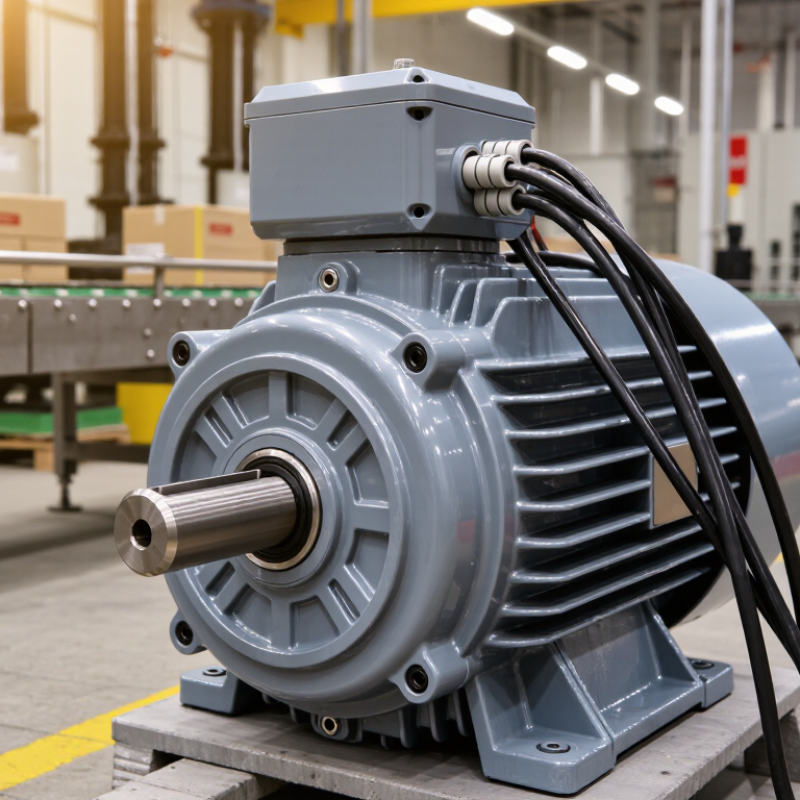
Why Choose a Rotary Motor for Global Applications?
A rotary motor converts electrical energy into continuous mechanical motion. That simple action supports pumps, conveyors, fans, and processing equipment worldwide. Frequency matters. A four-pole motor has a synchronous speed of 1,500 rpm at 50 Hz and 1,800 rpm at 60 Hz. Actual speed is slightly lower under load. This difference affects flow, torque, noise, and production timing. Motors designed for both systems can simplify international equipment planning, but only when voltage and frequency ratings match.
Tips: Check the nameplate before installation. Confirm voltage, frequency, phase, rated current, insulation class, and allowable temperature. Review the driven load at both speeds. A pump may move more fluid at 60 Hz, while a conveyor may require different control settings. Use suitable protection against overload, poor ventilation, and voltage imbalance. Small details matter.
Field experience shows that reliable operation depends on more than continuous rotation. Mounting alignment, bearing condition, cable length, and starting torque also deserve attention. Power systems are rarely perfect. I have seen a correctly rated motor overheat because airflow was blocked by a nearby panel. This is easy to overlook. For global applications, documented testing under both 50 and 60 Hz conditions provides stronger evidence than a rating label alone. A practical design leaves adjustment room. That habit improves confidence during commissioning and future service.
The ideal synchronous speed of an AC rotary motor depends on supply frequency and the number of magnetic poles: Speed (RPM) = 120 × Frequency (Hz) ÷ Number of Poles. The chart compares theoretical synchronous speeds for common motor pole configurations on 50 Hz and 60 Hz power systems. Actual induction-motor speed is slightly lower because of slip.
A rotary motor designed for global use must tolerate more than different plug shapes. Its voltage rating matters at the installation point. IEC 60038 identifies 230/400 V and 400/690 V as standard three-phase system voltages. This makes a 230–690 V motor range practical for factories, pumps, conveyors, and ventilation equipment across many regions.
The International Energy Agency estimates that electric motor systems consume about 46% of global electricity. In industry, motor-driven systems can represent roughly 70% of electricity demand, according to the IEA report Energy-Efficiency Policy Opportunities for Electric Motor-Driven Systems. These figures make voltage selection an efficiency issue, not only an electrical specification. A correctly matched motor can reduce transformer stress, cable losses, and unnecessary conversion equipment.
Small details matter. Check the nameplate, frequency, phase arrangement, starting method, and allowable voltage tolerance before ordering. A 690 V motor may reduce current in high-power applications, but it can require different insulation coordination and switching equipment. That assumption can be wrong. Site measurements should confirm supply stability, especially where long cables or heavy loads cause voltage drop. Installation records often reveal small phase imbalances that design documents miss. Not every site is perfectly balanced. A globally suitable rotary motor therefore needs flexible ratings, clear terminals, documented testing, and technicians who verify conditions instead of trusting the label alone.
Why Choose a Rotary Motor for Global Applications?
Energy efficiency becomes measurable when a rotary motor runs thousands of hours yearly. IEC 60034-30-1 defines IE3 and IE4 efficiency classes for qualifying electric motors. IE4 motors reduce operating losses more than IE3 designs under comparable conditions. The International Energy Agency reports that motor systems use about 53% of global electricity. Small efficiency gains can therefore produce significant savings across factories, pumps, fans, and conveyors. Real performance still depends on loading, temperature, voltage, and maintenance.
IE3 remains a practical choice for many global installations. IE4 can suit continuous-duty equipment with stable loads and high annual running hours. A field engineer should check the complete system, not only the nameplate. An oversized motor may operate inefficiently at light load. A poorly adjusted variable-speed drive can also weaken expected savings. That part is often underestimated. IEC efficiency values come from defined test conditions, while sites are rarely perfect. Dust, misalignment, and voltage imbalance can change results.
Tips: Compare IE3 and IE4 using lifetime energy costs, not purchase price alone. Request test certificates linked to IEC 60034-30-1. Check local grid frequency, enclosure protection, ambient temperature, and duty cycle before selection. The U.S. Department of Energy also emphasizes system-level motor efficiency, including pumps, fans, controls, and transmission components. In practice, a slightly less efficient motor may perform better when correctly sized. This is where specifications deserve another review.
| Evaluation Dimension | IE3 – Premium Efficiency | IE4 – Super Premium Efficiency | Global Application Implication |
|---|---|---|---|
| IEC 60034-30-1 Classification | |||
| Efficiency class | IE3 Premium efficiency |
IE4 Super premium efficiency |
The classes provide a common efficiency language for line-operated AC motors used in industrial and commercial systems. |
| Standard reference | Defined within the efficiency-class framework of IEC 60034-30-1. | Defined within the efficiency-class framework of IEC 60034-30-1. | Actual minimum efficiency values must be selected according to rated output, number of poles, frequency, and the applicable edition of the standard. |
| Efficiency threshold | Higher minimum efficiency than IE1 and IE2 for the same motor rating and pole configuration. | Higher minimum efficiency than IE3 for the same motor rating and pole configuration. | IE3 and IE4 should not be compared without matching motor power, speed, frequency, and operating point. |
| Primary loss reduction | Reduces electrical losses through improved electromagnetic design, conductor utilization, and material selection. | Further reduces losses through more optimized electromagnetic and thermal design, often with tighter manufacturing tolerances. | Lower losses reduce heat generation and can support longer operating life when the motor is correctly selected and maintained. |
| Energy and Operating Performance | |||
| Typical efficiency advantage | Provides a strong efficiency baseline for continuous-duty industrial equipment. | Can provide additional savings over IE3, especially in applications with long annual operating hours. | The business case is strongest for pumps, fans, compressors, conveyors, and other rotating equipment operating for extended periods. |
| Part-load behavior | Efficiency changes with load, speed, voltage, and operating conditions. | Efficiency also changes with load, speed, voltage, and operating conditions; the IE4 label does not guarantee the same percentage saving at every load. | Use measured or manufacturer-certified efficiency data at the expected duty point rather than relying only on the nominal class. |
| Thermal performance | Lower losses than lower-efficiency classes generally produce less internal heat at the same mechanical output. | Further loss reduction can decrease thermal stress at comparable operating conditions. | Cooling, ambient temperature, altitude, enclosure type, and installation ventilation still need to be evaluated. |
| Variable-speed operation | Suitable for inverter-based systems when the motor and drive are correctly matched. | Suitable for inverter-based systems when insulation, bearings, cooling, and control compatibility are properly specified. | System efficiency depends on the motor, variable-frequency drive, control strategy, mechanical transmission, and operating profile. |
| Reference Calculation: 11 kW, Four-Pole Motor at 50 Hz | |||
| Reference efficiency values | 91.4% at the stated reference point | 93.3% at the stated reference point | These values are an example for comparison and are not universal IE3 or IE4 limits for all motor ratings. |
| Approximate electrical input at 11 kW output | 11 ÷ 0.914 = 12.04 kW | 11 ÷ 0.933 = 11.79 kW | The IE4 example requires approximately 0.25 kW less input power at full rated output. |
| Annual energy use at 4,000 hours | Approximately 48,200 kWh/year | Approximately 47,200 kWh/year | Estimated difference: approximately 980 kWh/year, before considering drive and system losses. |
| Illustrative electricity-cost impact | At an electricity price of USD 0.15/kWh, the estimated annual energy-cost difference is approximately USD 147 per motor. | Actual savings depend on electricity tariffs, load profile, operating hours, maintenance, and the motor’s measured efficiency. | |
| Selection Considerations for Global Applications | |||
| Voltage and frequency | Specify the required voltage, frequency, phase, and connection method for the destination market. | Specify the same electrical parameters and confirm the motor’s certified performance at the intended frequency. | Common international systems include 50 Hz and 60 Hz supplies, with different voltage combinations by region. |
| Operating environment | Confirm enclosure, ingress protection, ambient temperature, altitude, humidity, and cooling method. | Apply the same environmental checks; higher efficiency does not eliminate the need for correct thermal derating. | Global installations may require different enclosure and insulation specifications for dust, moisture, heat, or corrosive atmospheres. |
| Regulatory compliance | May satisfy mandatory efficiency requirements in markets where IE3 is the applicable minimum class. | May support projects targeting higher efficiency, reduced lifecycle cost, or future regulatory requirements. | Regulatory requirements vary by country and product scope; verify the current local rules before procurement. |
| Total cost of ownership | Usually offers a balance between purchase price and long-term operating cost. | May have a higher initial purchase cost but can reduce energy expenditure over a long service life. | Compare purchase price, energy consumption, operating hours, maintenance, downtime risk, and expected service life. |
A rotary motor with the right enclosure can handle demanding industrial environments. The IEC 60529 rating provides a clear reference for protection against solids and water. IP55 means the enclosure limits dust entry and resists low-pressure water jets. IP66 offers stronger protection. It is dust-tight and designed for powerful water jets from multiple directions.
This difference matters in real facilities. A motor near a packaging line may face airborne powder, splashes, and frequent cleaning. An IP66 enclosure can reduce contamination risks during these conditions. In a dry warehouse, IP55 may provide adequate protection without unnecessary enclosure cost. The decision should match the actual exposure, not the most impressive label.
Installation still matters. Cable glands, terminal covers, shaft seals, and mounting surfaces must maintain the enclosure’s protection level. A damaged gasket can undermine a carefully selected motor. No enclosure is invincible. High-pressure cleaning, hot water, chemicals, or salt air may require additional material and maintenance checks. IEC 60529 testing does not automatically confirm resistance to every chemical or operating condition. That detail is easy to miss.
Technicians should inspect seals after transport and during scheduled service. They should also verify airflow, because excessive sealing can complicate heat dissipation. A reliable selection considers dust, water, temperature, cleaning methods, and local installation practices together. Sometimes the practical answer is less obvious.
Why Choose a Rotary Motor for Global Applications?
A rotary motor can simplify equipment design across different markets. Its rotating output suits pumps, conveyors, fans, compressors, and many automated machines. However, global interchangeability depends on more than motor power. IEC standards define common frame dimensions, mounting patterns, and performance expectations. NEMA standards use different frame conventions, shaft sizes, and mounting details. A motor that fits one system may not drop into another.
Check every measurement before ordering. Compare frame size, bolt spacing, shaft diameter, keyway, terminal position, voltage, frequency, and protection rating. UL compliance supports electrical safety requirements in applicable North American markets. CE marking indicates conformity with relevant European Union requirements, including applicable safety and electromagnetic compatibility rules. It is a declaration of conformity, not a universal quality award. Requirements can also change with the complete machine.
In field installations, a small mismatch can stop production. An adapter plate may solve mounting differences, but it can alter alignment and vibration. A higher efficiency rating may reduce operating costs, yet it can affect starting current and control settings. Review certificates, test reports, datasheets, and installation instructions from qualified engineers. Confirm whether the motor is certified as a standalone product or within a finished machine. This detail is often overlooked. It should not be. When standards, dimensions, and local electrical rules align, rotary motors become easier to source, replace, and maintain worldwide.
A 230–690 V range supports many three-phase systems worldwide. It can suit pumps, conveyors, fans, and factory machinery. Local verification remains necessary.
Correct voltage matching can reduce cable losses, transformer stress, and conversion equipment. A mismatch may cause overheating or unreliable starting. The label is not enough.
Check the nameplate, frequency, phase arrangement, starting method, and voltage tolerance. Also review enclosure protection, ambient temperature, and duty cycle. Small checks matter.
Higher voltage can reduce current in high-power equipment. However, it may require suitable insulation coordination and switching equipment. That assumption can be wrong.
Long cables and heavy loads can create voltage drops. Phase imbalance may also appear in installation records. Measure the supply when possible.
IE4 motors generally have lower operating losses than comparable IE3 motors. IE3 may remain practical for many installations. The best choice depends on load and operating hours.
IE4 often suits continuous-duty equipment with stable loads and long annual running hours. It may reduce lifetime energy costs. Purchase price is only one factor.
Yes. Oversizing, light loading, poor alignment, dust, and voltage imbalance reduce real performance. An incorrectly adjusted speed controller can also weaken expected savings. Specifications deserve another review.
Compare purchase cost, expected running hours, load profile, maintenance, and lifetime energy use. Request test documents based on recognized efficiency testing methods. Field conditions may differ.
A Rotary Motor is a practical choice for global applications because it delivers reliable continuous rotation across both 50 Hz and 60 Hz power systems. Its availability in voltage ratings from 230 to 690 V supports installation in a wide range of international electrical environments, reducing the need for major system modifications. This flexibility makes it suitable for industrial equipment, automation systems, pumps, fans, and other applications that require consistent mechanical performance.
Energy efficiency is another important advantage. Motors classified as IE3 or IE4 under IEC 60034-30-1 can help reduce operating losses and long-term energy consumption. Depending on the installation environment, IP55 to IP66 enclosures rated under IEC 60529 provide protection against dust and water. In addition, compatibility with IEC, NEMA, UL, and CE requirements can simplify equipment integration, certification, replacement, and maintenance across different markets.
