Why Choose an Electric Power Steering Motor?
Choosing the right steering technology affects safety, efficiency, comfort, and vehicle design. An Electric Power Steering Motor supports accurate assistance without relying on a continuously driven hydraulic pump. That difference can reduce parasitic energy loss, especially during straight-line driving. It also helps manufacturers improve fuel economy and extend electric-vehicle range.
“Steering is a key technology for the vehicle of the future,” says Dr. Peter Holdmann, a recognized automotive steering specialist and former Bosch Automotive Steering executive. His view reflects a practical engineering reality. Modern vehicles need steering systems that respond quickly, communicate road conditions, and integrate with driver-assistance functions. An Electric Power Steering Motor can provide variable assistance based on speed, steering angle, torque, and driving conditions. The wheel feels lighter during parking. It becomes firmer at highway speeds.
Small details matter.
A properly selected motor must match the rack, control unit, thermal limits, and vehicle mass. Poor matching may create noise, uneven assistance, or uncomfortable steering feedback. Engineers also examine durability, electromagnetic compatibility, sensor accuracy, and fail-safe behavior. These checks require testing, not optimistic assumptions.
The technology is not perfect. Road feel can sometimes seem less natural than traditional hydraulic systems. Software faults and sensor errors also demand careful protection. Still, thoughtful calibration and reliable components can address many concerns. This article explores why an Electric Power Steering Motor remains an important choice for efficient, responsive, and increasingly software-defined vehicles.
Why Choose an Electric Power Steering Motor?
What Is an Electric Power Steering Motor?
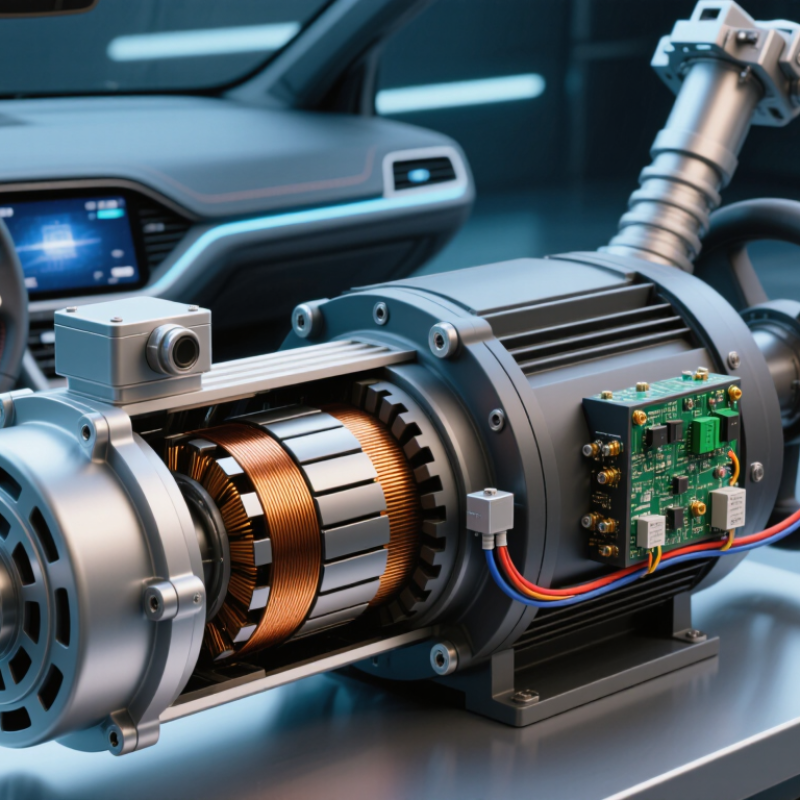
An electric power steering motor is an electromechanical actuator that helps turn the wheels. It receives signals from a torque sensor, steering angle sensor, and vehicle control unit. The motor then adds assistance through a belt, column, or rack-mounted mechanism.
Unlike hydraulic systems, it does not need a continuously running pump. U.S. Department of Energy technical assessments estimate that electric power steering can improve fuel economy by about 2–4% by reducing engine-driven losses. That figure varies with vehicle size, calibration, and driving conditions. Real-world results are rarely perfect.
The motor also supports variable assistance. At low speed, it can provide stronger torque for tight parking turns. At highway speed, assistance decreases, helping the steering feel more stable. A 2024 International Energy Agency report recorded almost 14 million electric car sales worldwide in 2023. This growth increases demand for efficient, electronically controlled steering systems.
A reliable design still needs more than a powerful motor. Engineers must control heat, vibration, sensor accuracy, and fault responses. A motor that feels smooth in a workshop may behave differently after prolonged hill driving. That assumption needs testing. Careful calibration matters.
An electric power steering motor provides steering assistance only when it is needed. Compared with hydraulic systems, EPS can reduce parasitic engine load, support vehicle efficiency, simplify packaging, and enable functions such as lane keeping and automated parking.
The chart shows representative peak motor-power ranges commonly used in EPS engineering for different vehicle applications. Actual motor sizing depends on vehicle mass, steering geometry, tire friction, assist strategy, and system voltage.
An electric power steering motor helps the driver turn the wheels with less physical effort. Unlike hydraulic systems, it does not need a continuously running pump or pressurized fluid. The motor receives information from a torque sensor, steering angle sensor, and vehicle-speed data. A control unit compares these signals within milliseconds. It then decides how much assistance the driver needs.
At low speeds, the motor provides stronger support for parking and tight turns. At higher speeds, assistance decreases, helping the steering feel more stable. The motor transfers force through a reduction gear, steering column, or rack-mounted mechanism, depending on the vehicle design. The driver still controls the steering directly. The motor only adds measured torque.
Small details matter. A weak battery, damaged wiring, or poor sensor calibration can change steering response. Warning lights may appear before the problem feels serious. Technicians usually check stored fault codes, power supply, sensor readings, and mechanical resistance. It is not flawless. Some drivers may mistake normal steering feedback for a motor fault. Others may ignore a brief warning because the vehicle still turns. That assumption can become unsafe. Careful testing is more reliable than replacing parts based on noise alone. During inspection, unusual clicking, uneven assistance, or a heavy steering feel deserves attention.
| Data Dimension | Typical Information | Practical Meaning |
|---|---|---|
| Primary Function | Provides electric assist to reduce the driver's steering effort. | The motor supplements the driver's input instead of mechanically turning the wheels by itself. |
| Power Source | The vehicle's low-voltage electrical system, commonly 12 V in passenger vehicles. | Assistance can be supplied without a continuously running hydraulic pump. |
| Main Control Inputs | Steering torque, steering angle, vehicle speed, motor position, and system status. | The electronic control unit uses these signals to calculate the required level and direction of assistance. |
| Core Operating Sequence | Sensor measurement → control calculation → motor-current command → gear or belt transmission → steering assist. | The system continuously adjusts motor output while the steering wheel is being turned. |
| Motor Type | Usually a compact, electronically commutated permanent-magnet motor. | This design provides controllable torque and is suitable for frequent changes in steering direction. |
| Torque Measurement | A torque sensor detects the driver's steering effort, often through a torsion-bar-based sensing arrangement. | Greater driver input generally causes the controller to request greater motor assistance, within system limits. |
| Speed-Based Assistance | Higher assistance is generally used at low speeds, while assistance is reduced at higher speeds. | Low-speed parking becomes easier, while higher-speed steering can retain a more stable and natural feel. |
| Energy Use | Power is mainly consumed when steering assistance is required. | Unlike a belt-driven hydraulic pump, the motor does not need to operate continuously simply to maintain hydraulic pressure. |
| Hydraulic Fluid Requirement | No hydraulic pump, fluid reservoir, pressure hoses, or hydraulic steering fluid is required for a fully electric assist system. | This can reduce fluid-related maintenance and eliminate hydraulic leakage points. |
| Steering Assist Locations | Common layouts include column-assist, pinion-assist, and rack-assist designs. | The motor's location affects packaging, steering feel, load capacity, and the type of steering gear used. |
| Control Precision | Software can vary assist according to steering torque, vehicle speed, driving mode, and fault status. | The same hardware can support different steering characteristics without changing the basic mechanical linkage. |
| Regenerative Capability | The motor can generate electrical energy during some overrun or corrective steering conditions, although the amount is limited. | Energy recovery is possible in principle, but it is not the primary purpose of the steering motor. |
| Mechanical Connection | Most road-vehicle systems retain a mechanical connection between the steering wheel and the road wheels. | The driver can normally retain direct steering control even when electric assistance is unavailable, although steering effort increases. |
| Fail-Safe Behavior | Fault detection can disable or reduce assistance and illuminate a warning indicator. | A loss of electrical assist generally results in heavier steering rather than automatic steering input, subject to the vehicle design. |
| Diagnostic Functions | The controller can monitor sensor plausibility, motor current, temperature, voltage, communication, and internal faults. | Electronic diagnostics help identify problems that may be difficult to detect through a purely hydraulic system. |
| Thermal Management | Motor and control electronics are designed with temperature monitoring and protection strategies. | Assistance may be limited temporarily if repeated steering loads cause excessive heat. |
| Packaging Advantage | The system uses electrical wiring and a motor rather than a hydraulic pump, reservoir, and pressure lines. | Automakers have greater flexibility when arranging the engine compartment and steering components. |
| Vehicle Efficiency Potential | Reduced continuous accessory load can support lower parasitic losses compared with continuously driven hydraulic assistance. | The actual efficiency benefit varies with vehicle mass, steering hardware, driving conditions, and control calibration. |
| Integration Potential | Electronic control enables compatibility with functions such as automated parking assistance and lane-centering support when the complete vehicle system is designed for them. | The motor becomes an electronically controllable actuator within broader driver-assistance functions, while safety requirements remain essential. |
| Why Choose It? | Efficient on-demand assistance, reduced hydraulic complexity, software-based control, flexible packaging, and integrated diagnostics. | Electric power steering is well suited to modern vehicles that require precise control, improved efficiency, and compatibility with electronic driver-assistance systems. |
Note: Exact motor output, gear ratio, assistance level, voltage architecture, and failure response vary according to vehicle design and steering system configuration.
Why Choose an Electric Power Steering Motor?
What Benefits Does Electric Power Steering Provide?
Electric power steering supplies assistance only when the driver needs it. A hydraulic system often drives its pump continuously, even on straight roads. The U.S. Department of Energy’s Vehicle Technologies Office estimates that electric steering can improve fuel economy by 2–4%. That saving may sound small. Across a large vehicle fleet, however, it becomes meaningful.
The motor also supports precise software control. Assistance can change with speed, steering angle, and road conditions. Parking feels lighter, while highway steering becomes firmer. The driver notices less effort beside a curb. The system can also communicate with lane-keeping and automated parking functions. That integration is difficult with a purely hydraulic arrangement.
Electric steering reduces hoses, fluid, and engine-driven hardware. This can simplify packaging and lower routine maintenance needs. The European Commission’s 2023 emissions monitoring report recorded average new-car emissions near 106 grams of CO2 per kilometre. Every efficiency gain matters under that pressure. Yet EPS is not automatically better in every situation. Motor noise, sensor faults, and software calibration still require careful engineering. Real-world savings vary with vehicle mass, tire pressure, traffic, and driving style. The headline number needs context.
Why choose an electric power steering motor? The stronger answer appears when it is compared with a hydraulic system. An electric motor assists steering only when assistance is needed. A hydraulic pump often spins whenever the engine runs. That constant load can increase fuel use, especially during low-speed maneuvering. Electric assistance also allows precise control of steering weight. Engineers can adjust it for parking, highway driving, or emergency correction.
Hydraulic steering still has a convincing advantage: natural road feedback. Pressure changes through the fluid can make the wheel feel progressive and familiar. Electric systems may feel lighter or filtered, particularly when calibration is poor. That criticism is fair. During a workshop inspection, a technician may find hydraulic leaks around hoses, seals, or the steering rack. Electric systems remove those fluid-related service points. They still need careful checks of wiring, sensors, grounds, and motor temperature.
The electric motor can deliver assistance efficiently, but it depends on software and stable voltage. A weak battery or poor connection may trigger warning messages or reduce assistance. Hydraulic systems are not perfect either. Cold fluid can make steering heavy, while worn pumps may whine near full lock. I would not call electric steering universally better. Its performance depends on vehicle size, driving demands, calibration quality, and repair support. In practical testing, steering feel matters as much as energy savings.
Choosing an electric power steering motor requires more than checking peak torque. The motor must deliver smooth assistance during low-speed parking and stable control at highway speed. Torque density, response time, voltage compatibility, and thermal capacity deserve close attention. A motor that performs well on a test bench may struggle after repeated steering cycles in a hot engine bay.
Fortune Business Insights reported that the global EPS market was valued at about $29.73 billion in 2023. Its 2024 report projects growth to approximately $47.58 billion by 2032. This expansion increases demand for compact, efficient, and safety-focused motors.
Check rated torque, not only maximum torque. Review current draw, noise, vibration, sensor compatibility, and communication requirements. Functional safety evidence also matters. ISO 26262 alignment can support risk control, but certification claims should be verified carefully. A missed detail remains possible.
Tips:
Match the motor to the steering rack, vehicle mass, and supply voltage. Test repeated parking maneuvers, cold starts, and thermal recovery. Measure assist consistency after continuous operation. Keep installation space and connector orientation practical. A lower-cost motor may create higher calibration and warranty risks. Ask for endurance data, failure-mode analysis, and traceable test conditions before approval.
It is an electromechanical actuator that helps turn the vehicle’s wheels. Sensors measure steering torque and wheel angle. A control unit then adjusts motor assistance. The motor may drive the column, belt, or steering rack.
It does not need a continuously running hydraulic pump. This can reduce engine-driven losses and improve fuel economy by about 2–4%. Actual savings vary with vehicle size and driving conditions. The result is not always perfect.
Strong assistance helps during slow parking turns. Reduced assistance supports stability at highway speeds. For example, a tight parking maneuver may require higher motor torque. Calibration determines how natural the steering feels.
Check rated torque, not only peak torque. Review response time, voltage range, current draw, and torque density. Noise and vibration also matter inside the cabin. A large peak number can mislead.
The motor must tolerate repeated steering cycles and hot surroundings. Test continuous operation, hill driving, and thermal recovery. A workshop test may not represent a heated engine bay. That assumption needs questioning.
Match the motor with the steering rack, vehicle mass, and supply voltage. Check sensor interfaces, communication requirements, connector position, and installation space. A connector facing the wrong direction can complicate assembly. Small details matter.
Test cold starts, repeated parking turns, highway operation, and sudden load changes. Measure assistance consistency after prolonged use. Request endurance results and failure-mode analysis. Test conditions should be traceable. Missing data remains possible.
Not necessarily. A cheaper motor may increase calibration, repair, and warranty risks. Review thermal data, sensor accuracy, vibration behavior, and safety evidence. Claims about compliance should be verified carefully. The lowest price can become expensive later.
An Electric Power Steering Motor is the key component that assists the driver’s steering effort through electronically controlled motor support. Unlike traditional systems that rely on a continuously running hydraulic pump, it responds to steering input, vehicle speed, and driving conditions to provide the appropriate level of assistance. This design can improve steering precision, reduce driver fatigue, and support smoother handling in urban traffic, parking, and high-speed driving.
When compared with hydraulic steering, electric power steering generally offers lower energy consumption, simpler packaging, and fewer maintenance concerns because it does not require hydraulic fluid, hoses, or a mechanical pump. However, choosing the right EPS motor requires careful attention to torque output, response speed, durability, operating temperature, noise and vibration performance, control compatibility, and installation requirements. A suitable motor should match the vehicle’s steering system and deliver reliable assistance throughout its expected service life.
