How to Choose the Right Robotics Motor?

Time:2026-10-30 Author:Isabella
0%

Choosing a Robotics Motor is not simply a matter of finding the highest torque or fastest speed. The right choice depends on the job: the load, motion profile, operating time, available power, and environment. A small gripper may need smooth, controlled movement more than raw force. A mobile robot climbing a ramp faces a different challenge, where wheel torque, heat, and battery life all matter. Small details matter.

Robotics pioneer Rodney Brooks wrote, “The world is its own best model.” That idea is useful when selecting a motor: real operating conditions can expose limits that a specification sheet does not show. Compare continuous and peak torque, check speed across the expected load, and consider the driver, gearbox, encoder, and mounting space as part of the system. A motor that looks ideal on paper may run hot, draw too much current, or leave little room for a reliable gearbox. It happens.

This guide explains how to match motor type and performance to a robot’s task, then assess the practical trade-offs before purchase. It covers torque, speed, power, control, thermal limits, and integration, with attention to details engineers can verify in a datasheet or prototype test. No single motor fits every build. The selection process can still be imperfect: early estimates may miss friction, shock loads, or changing payloads. Testing under realistic conditions helps reveal those gaps before they become design problems.
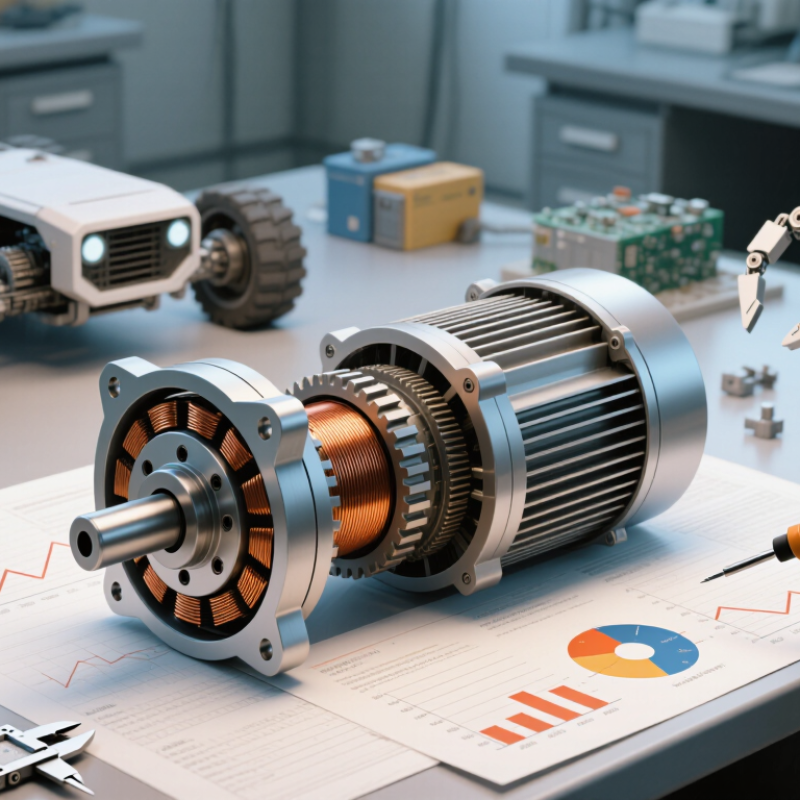
How to Choose the Right Robotics Motor?

Define the Motion Requirements of the Robot

Before selecting a motor, describe the robot’s actual motion, not just its maximum speed. Will it lift a load, turn a wheel, or move an arm through repeated cycles? Record the payload, travel distance, desired acceleration, and time available for each movement. Small details matter. A mobile robot climbing a ramp needs more torque than one rolling across a smooth floor, even if both travel at the same speed.

Estimate the force or torque required at the moving part, then account for wheel radius, gearing, friction, and the robot’s inertia. Check both peak torque during acceleration and continuous torque during normal operation. The motor must also meet the duty cycle: a brief lift differs from holding a load for several minutes. That changes everything. Consider whether the robot needs precise stopping, smooth low-speed movement, or resistance to being pushed while stationary. Measure the real load if possible; calculations based on ideal conditions are often too optimistic. I would revisit the estimates after testing a prototype, because cable drag, uneven floors, and small alignment errors can change the motion more than expected. Define these requirements before comparing motor specifications.

How to Choose the Right Robotics Motor?

Define the robot’s motion requirements before selecting a motor. Compare the target peak torque and operating speed for each motion task.

Illustrative targets only—not universal specifications. Actual requirements depend on payload, gearing, acceleration, friction, and duty cycle. Verify continuous torque and thermal limits for your design.

Identify Motor Types and Their Operating Principles

Choosing a robotics motor starts with how it produces motion. A brushed DC motor uses brushes to switch current and create continuous rotation; it is simple to control, but brush wear can limit service life.

A brushless DC motor switches current electronically, usually improving efficiency and reducing routine maintenance. A stepper motor advances in discrete increments, making positioning straightforward when loads are predictable. But under sudden load, it can miss steps without reporting the error.

A servo is a motor paired with feedback and control electronics. An encoder measures position or speed, allowing the controller to correct motion as it happens. That matters when a robot arm must stop precisely beside a fixture, not merely rotate.

The International Federation of Robotics reported 541,302 industrial robot installations in 2023 in World Robotics 2024, reflecting the varied motion demands across automation.

Heat matters. Compare torque-speed curves, peak and continuous torque, duty cycle, and gearbox losses—not just rated power. A motor that fits a brief bench test may overheat during repeated cycles.

I have found that selection is rarely tidy: a smaller motor with gearing can outperform a larger direct-drive option, but backlash may undermine accuracy. Test the real payload and motion profile before committing.

Compare Torque, Speed, and Power Needs

How to Choose the Right Robotics Motor?

Compare Torque, Speed, and Power Needs

Start with the robot’s real job, not the motor’s headline specifications. A small wheeled platform on a smooth floor needs less drive torque than one climbing a ramp. Estimate the load, wheel radius, and acceleration you need. Then calculate the torque required at the wheel, allowing extra capacity for friction and uneven surfaces. Real conditions are rarely perfect.

Check whether the motor can provide that torque continuously. Stall torque describes a stopped shaft and is not a practical operating target; prolonged operation near it can overheat the motor. A gearbox can trade speed for torque, but it also adds friction and may introduce backlash. Look at the torque-speed curve, not just one impressive number. Details matter.

Speed should match the robot’s task. A fast motor may still produce poor movement if the gearing is wrong or the load is heavy. Power links torque and rotational speed, so compare all three at the intended operating point. Also check the battery’s voltage and current limits, plus the motor driver’s capacity. Test with the actual wheels and payload, then measure current and temperature. My estimates may be off; a brief bench test often exposes assumptions that calculations miss.

Check Electrical and Mechanical Compatibility

A robotics motor must match both its controller and the mechanism it drives. Check supply voltage, continuous current, and peak current against the driver’s limits. Then compare the motor’s torque-speed curve with the load’s needs; a high stall-torque figure alone does not prove it can move a robot arm quickly. The U.S. Department of Energy’s 2014 United States Industrial Electric Motor Systems Market Opportunities Assessment estimates that motor-driven systems use about 68% of U.S. industrial electricity. That figure concerns industrial systems, not small robots, but it shows why efficient matching matters. Small mismatches matter.

Mechanical fit is just as important. Confirm shaft diameter, mounting pattern, available space, gearbox ratio, and load inertia. A motor may fit the bracket yet struggle when a long arm swings or a wheel meets carpet. Check duty cycle and cooling, too: repeated starts can create heat that a short bench test misses. I would leave some margin, then test with the actual payload. A spreadsheet can overlook vibration, friction, or a connector that loosens under movement.

Tips: Measure voltage at the motor during acceleration, not only at rest. Record current, temperature, and travel time under load. Compare these readings with the motor and driver datasheets, including their continuous ratings. If the assembly heats up or slows down, revisit the gearing or load before choosing a larger motor.

Evaluate Control, Feedback, and Operating Conditions

Choosing a robotics motor starts with the motion you need to control. A joint that must hold a camera steady needs different behavior from a wheel that runs at constant speed. Check required torque across the full movement, not just at startup. Then consider acceleration, load changes, and how often the motor reverses. Small calculations help, but real mechanisms often add friction and flex.

Control and feedback should match the task. An open-loop motor may suit simple, repeatable movement, but it cannot confirm that the shaft reached its target. Encoders provide position or speed data, while current sensing can help reveal stalls or unexpected loads. More feedback adds wiring, setup, and tuning work. Keep it practical. A highly precise sensor is not useful if the controller cannot read it reliably or the mechanism has too much backlash.

Operating conditions matter just as much. Note the expected duty cycle, ambient temperature, dust, moisture, and vibration near the motor. A motor that performs well on a cool test bench may overheat inside a tight enclosure after repeated starts. Leave room for cooling and check the manufacturer’s thermal limits. One detail is easy to miss: cables and connectors can loosen under vibration. Test the motor with the actual payload and mounting arrangement. Early estimates can be wrong, so measure current and temperature during a realistic trial.

FAQS

Which electrical ratings should I check before choosing a motor?

Match its supply voltage, continuous current, and peak current to the driver’s limits. Check both datasheets.

Is a high stall-torque rating enough?

No. Compare the torque-speed curve with the load and required movement speed. Stall torque alone can mislead.

What mechanical details affect motor fit?

Check shaft diameter, mounting pattern, space, gearbox ratio, and load inertia. A motor can fit yet struggle with a long arm.

Why test with the actual payload?

Real loads reveal friction, vibration, and slowing that a bench test may miss. Estimates can be wrong.

When should I use an encoder?

Use position or speed feedback when the motor must confirm its movement. Open-loop control cannot verify that the shaft reached its target.

How can I spot overheating?

Record temperature and current during repeated starts and realistic operation. A cool bench test is not enough.

What should I measure during acceleration?

Measure voltage at the motor, along with current and travel time. Compare the readings with continuous ratings.

Can vibration cause problems beyond motor performance?

Yes. Cables and connectors may loosen during movement. Check them under the actual mounting arrangement.

How much feedback and tuning should I add?

Add only what the task needs. More sensors mean extra wiring and setup, and a sensor cannot fix excessive backlash. Reconsider the design.

Conclusion

Choosing the right Robotics Motor begins with defining what the robot must do. Consider the type and range of motion, the load it will move, how quickly it must respond, and how often it will operate. These requirements help narrow the options, such as motors suited to continuous rotation, precise positioning, or high-force movement. Understanding how each motor type produces motion also makes it easier to select one that fits the task.

Next, compare the required torque, speed, and power, allowing for real-world loads rather than ideal conditions alone. Check that the motor’s voltage, current, dimensions, mounting points, and shaft fit the robot’s electrical and mechanical design. Finally, consider the controller, feedback sensors, and operating environment, including temperature, vibration, and duty cycle. A well-matched motor should meet performance needs while integrating reliably with the robot’s control system.

Isabella

Isabella

Isabella is a dedicated marketing professional with a sharp focus on driving brand growth and engagement through strategic content creation. With an extensive background in digital marketing, she combines her passion for storytelling with her keen understanding of industry trends to deliver......